Blog Archive

Showing posts with label champions. Show all posts

Saturday, 12 January 2013

One Month to Go: The Champions League Gears up for the Quarters - by Christopher Morgan

The Champions League is the best football competition in the world for one simple reason: It brings together Europe’s elite football teams, teams full of talent and tantrums, brilliance and barbarism, and pits them against one another in a glorious battle to the death.

Each year the competition showcases the world’s greatest football players, tactics and managers. Players such as Cristiano Ronaldo, Messi, Ribery, and Van Persie get to show off their footballing gifts to millions of people, there is also the added bonus of Jose Mourinho showing off his sociopathic dad routine, and Sir Alex Ferguson’s constant ‘wasp’ chewing.


This year promises to be a mouthwatering display of Europe’s finest, and the footballing gods have delivered a Quarter final line-up of the highest calibre. With matches such as Manchester United vs. Real Madrid and AC Milan vs. FC Barcelona, football fans the world over are just waiting for January to tick down.
Last year, the trophy was won by the least likely of winners, Chelsea, who this year have already been knocked out of the competition, stopping them from retaining the trophy for a consecutive year; a feat not achieved since, bar AC Milan’s back to back victories in old European Cup format in 1989-90.
A Bit of History

Since the competition’s inception, there have been 22 different club winners, with 12 winning the coveted trophy more than once. Real Madrid have the highest affinity with the cup, with no less than 9 wins and 3 runners up medals. AC Milan, interestingly, come a close second with 7 wins and 4 runners up medals.
Madrid can lay claim to best goal scored in the final, with Zinedine Zidane’s left footed volley from the edge of the penalty area against Bayer Leverkusen in the 2001-2002 final.
 
2012/13 Competition

This season the competition has already knocked out a few possible contenders for the trophy. Chelsea, as previously mentioned, were knocked out in the group stages; and Manchester City, who were hoping to improve on last season’s early knock out of the competition and finally mount a solid attack on a first ever Champions League triumph, were once again an early casualty.
 
The once Dutch ‘giant’ Ajax were also knocked out during the group stages, lagging behind Mourinho’s Real Madrid by a huge seven points. Lille, last year’s Ligue 1 runners-up, finished bottom of Group F, winning only a single match and losing every other.


This year’s last 16 will be a fascinating affair. With the reigning champions already knocked out, and with the new footballing powers such as Shakhtar, PSG and Dortmund attempting to make the jump up the big boy’s table, who are flexing their muscles ready for action - we will certainly be spoilt for choice come the 12th of Feb.  
Links and Pictures: BBC Sport, The Daily Telegraph, talksport.co.uk, youtube.com, bleacherreport.com
Catch up with Chris on his blog: http://notionsofawriter.tumblr.com/archive

Saturday, 1 December 2012

West Ham 3 - Chelsea 1 Match report

 
Pressure increases on Rafa as West Ham brush Chelsea aside


Chelsea’s season hit a new low today as they slipped to a damaging 3-1 defeat against a spirited West Ham side in the early London derby at Upton Park.

The Hammers fully deserved their victory against the struggling blues, with second half goals from Carlton Cole, Mohamed Diame and Maiga consigning Rafa Benitez to his first defeat as interim boss, and leaving Chelsea without a win in seven Premier League games.

It was Chelsea who started the game brighter, zipping the ball round with growing confidence in the first half. Benitez had spoken of the need to quicken the attacking tempo, and it was evident that his words were having an effect. Juan Mata ran the first half with his guile and intelligent passing, and capped it off with a fine finish from Torres’ cutback.

Changes were needed by Sam Alladyce at half time, with West Ham in dire need of more drive in the midfield. Sending on Matty Taylor and Mohamed Diame, West Ham came out fighting; battling harder for every ball, and showing much more adventure in the final third.

They fully deserved an equaliser, and it duly arrived courtesy of Carlton Cole, who rose higher than Ivanovic to knock the ball past a static Peter Cech following a Jarvis cross.

The Hammers went from strength to strength, consistently putting the beleaguered Blues to sword. It was no real surprise then when Man-of-the-match Diame fired in West Ham’s second from the edge of the box, leaving Chelsea with a mountain to climb with just ten minutes to go.

The fight-back never materialised, and with Blues fans starting up their ‘Rafa out’ chants, West Ham put the game to bed with Maiga slotting in a rebound after Taylor had his initial effort palmed away by Cech.

With two draws and a loss today, Benitez’s position as a figure of hate for Chelsea fans has only been further consolidated. He said that he would win over the fans by winning games and trophies, but with every passing game, his job of changing fans opinions over his acrimonious appointment becomes seemingly more and more hopeless.

Monday, 19 November 2012

The Trouble With Money


Speaking from a personal standpoint - the chance to earn a promotion in the workplace, and with it a large salary increase and additional professional respect is something all us working people strive for, and often crave on a daily basis. So why is it that when a footballer, when given the chance to ply his trade at a world-renowned club, can be roundly criticised from all corners as if it were a decision that warranted collective pity? We wouldn’t condemn a sales assistant’s choice to take a manager’s position? We wouldn’t look on with scorn if an actor earned his big break by scoring a part in a Hollywood blockbuster; but football is an entirely different arena.
 
Take Scott Sinclair for example. The 23-year-old winger started life at league two outfit, Bristol Rovers, before moving to the glitz of the Kings Road, Chelsea. After a series of mixed experiences on loan from the London club, he ended up being taken on by Swansea City. At this stage, Sinclair had gone from promising young firework, to a ‘nearly’ player settling for a league that suited his ability. No doubt he was capable of real dramatics, but these he showed all too rarely.

To his credit, Sinclair took up the challenge of reinvigorating his dwindling career, and starred in the Welsh club’s rise to the Premier League. Back on the big stage, he continued his fine efforts, playing all 38 games that season, and scored eight times. Scott Sinclair had arrived back on the scene it seemed, and he was out to prove his doubters wrong. But, regardless of his heroics for the Swans, it was still clear in many fans and pundits minds, that Sinclair had indeed found his level: over-performing for an over-achieving side that were enjoying Premier League status and surprising everyone with their continuing survival.


But then, in came Manchester City. Fresh from their first league title for forty-four years, the champions were looking to strengthen their already formidable squad. There were many who looked on in surprise at City’s decision to go in for the winger last summer, considering his non-existent international pedigree, and the brilliance of City’s existing team. It wasn’t just Swansea fans that thought that Scott’s ‘promotion’ was a dangerous, potentially career- threatening decision. And here we are, not four months later, with Sinclair already not considered for top flight games for City. How achingly predictable.

There have been many other examples over the years. Chelsea are in fact chief culprits of signing players everyone could see would not make the grade. Scott Parker, Steve Sidwell, Tal Ben Haim, and Shaun Wright-Philips came and went, not before showing the world on the biggest stage possible, that they were indeed not good enough to bounce with the big boys. These players opt for a joyride on the billionaires’ crooked rainbow, all the way down to the comforting pot of gold at the bottom.
Is it me, or are these types of signings so obviously wide of the mark, that they can be condemned even before the player has taken his seat for the first of many stints on the bench?

But can we blame the players for giving it a shot?
Maybe the agents for pushing their charges into firing line with contrived promises of grandeur?
Or is it the internal politics at ‘super-clubs’, which can see them enter bizarre summer dealings, and sign obscure ‘talent’ when points need to be made, examples set, and precedents changed?

Money talks, as we all know, but nothing is perfect.  
 
Photo credits: Daily Mail, The Mirror, financialexpress.com, glitterazi.com

Sunday, 21 October 2012

Myths and Legends 1.0

As a devout football fan, it is always a sad day when my heroes retire from the game. They seem to be indestructible, but we all know in the back of our minds that the day will come for even the most ageless of idols to hang up their boots. Similarly, loyalty and decade long consistency must eventually come to an end, and club legends gracefully, or even abruptly, pass into club folklore, moving to obscure new horizons for one last blaze of glory. It hurts when reality kicks in, and one realises that football is finite.

              Nike: The Mission - the best football advert? Check out Batistuta's below!

It is just this reality check that makes it all the more sweet when the unthinkable occurs, and players triumphantly return to the limelight, and perform, for however briefly, once more for an adoring crowd. We have seen players come out of retirement to help their ailing club; players, who have such a love of the game, continue plying their trade in far off leagues, or even divisions far below the prying eyes of Sky Sports cameras; we have even seen legends take up new sports, and succeed even further.  It warms the cockles of my heart to such an extent, that I feel it necessary to chronicle their exploits as and when they happen – when the Footballing Gods redeliver such opulent figures of our childhood.

1.      Edgar Davids
 

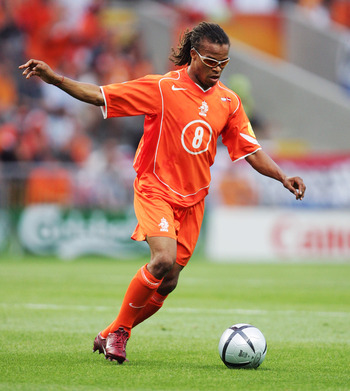
The bespeckled Dutch terrier has jumped into the papers recently, as he geared up for another bash at lower league English football, this time with League 2 side, Barnet. After coming out of retirement in 2010 to briefly turn out for Crystal Palace, we can now see him, at the age of 39, haring around the Underhill Stadium in North London, ensuring that the ‘Pitbull’s’ legacy continues in the form of bumps and bruises to bewildered Football League players.

Most recently, Davids inspired his new side to a resounding 4-0 win over Northampton. He played the 90 minutes, and even made himself captain for the game. Davids was named man-of-the-match.
 
Speaking after the game, he said, “I feel the man-of-the-match belongs to the whole group because it was a team effort.
'We saw that they really had a lot of energy and I’m proud of them because the tactical things we worked on all week they executed them."

Did you know: Edgar Davids wears his trademark protective glasses on the pitch, as he suffers from glaucoma.
And...Davids vs dump truck...wish it was real!
2.      Alessandro Del Piero


Juventus through and through, the Italian maestro brought his 19-year association with the ‘Old Lady’ to an end this year, when he joined Australian A-League outfit, Sydney Fc. The 37-year-old signed a two year deal with the club, making him the highest paid player in the league.

Speaking about his last game and leaving his beloved Juventus, Del Piero said, "The fans went above and beyond that day, no one had actually told me that I would never play for Juve again, but I knew that was the case. I saw the board go up with my number on it and asked myself: 'Do I really have to say goodbye? Do I have to leave the stadium for the last time?'

"I bowed to all four stands and waved to my family. I wanted to take it all in but I remembered where I was and told myself: 'Ale, get off, it's over'. But the fans made me come back out on to the pitch. I did two laps of honour and they threw hundreds of scarves at me. I saw people crying. I suppose it went well, but goodbyes always leave a bitter taste in the mouth."

A true genius of the game, Del Piero has continued to delight, scoring twice in his first three games – with one a wonderful free kick.


Did you know: When Juventus were relegated to Serie B in the Italian match fixing scandal in 2006, Del Piero was one of their high-profile players that stayed with the ‘Old Lady’ to help win immediate promotion. On his decision to stay, he said, “A true gentleman never leaves his Lady”

And...even though I cant speak Italian, these advert outtakes with Totti are brilliant.
 

3.  Gabriel Batistuta
 

‘Batigol’ was one of those players with a shot like a bolt of lightning. Goalkeepers risked losing an arm if they attempted to get near one of Batistuta’s pile-drivers! Retiring in 2005 after breaking the record for most goals scored in a season in the Qatar league (he ended his time there with 25 goals in 21 games, aged 36), Fiorentina legend Batistuta was last seen on the sporting scene in 2009, trying his hand at polo! Procuring his own polo club, it seemed as if his insatiable hunger for success would never leave.

It was short lived however, realising that his great talent lay with the football. "I was awful!” he said after his first polo match,  “The important thing is I'm learning and I'm having fun, but you cannot change who you are, and I want to do things well even if I'm not a professional."

Did you know: Batistuta currently runs his own construction company in Argentina and works as technical secretary to Argentine club, Colon.
Pictures: bleacherreport.net, backpagelead.com.au, thefootballproject.net
Links: BBC Sport, Wikipedia
Videos: youtube - owned individually

Sunday, 5 August 2012

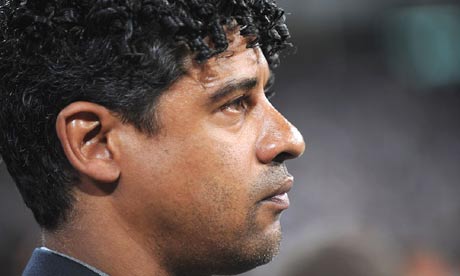
Unfinished Symphony: Frank Rijkaard – the Forgotten Manager of Total Football


Pep Guardiola has been universally hailed as a visionary manager; transforming Barcelona, and by association, Spanish football into an unstoppable force comprised of technique, skill and potency. The world looked on in enviable awe as Spain swept aside all who came before them at Euro 2012, taking Barcelona’s now famous ‘Tiki-Taka’ style of play to a whole new level of intricacy and sheer brilliance.

With Guardiola now departing and the relatively unknown Tito Vilanova faced with the ominous task of succeeding him at the Catalan club, the mind casts back over the last decade of Barca dominance, and falls upon a name swept unceremoniously aside in the wake of the Guardiola era; Frank Rijkaard; the Dutchman who has found himself lost in transition managing the Saudi Arabian national team, after creating the original beast, and setting into motion the era of Catalonian and overall Spanish dominance.

Branded with the same scalding iron as past greats such as Zinedine Zidane and Rivaldo; as a player, he is generally remembered for non-footballing reasons, namely his fluid ridden altercation with the sponge haired Rudi Voller. But, Frank Rijkaard was an exceptional player; a brutal defensive midfielder, with a dash of class and obvious pedigree.

Originally a centre-back at his first club Ajax, he was also deployed as a right midfielder, and also in centre-midfield. Finally settling on a defensive midfield role with AC Milan and on the international stage with Holland, he complemented his defensive game with lung bursting runs from deep, latching onto loose balls, and burying powerful headers. He was a footballer with the ability to play almost anywhere on the pitch, something that he surely took from his playing days and attached to his ‘complete football’ ideal upon entering management.
After taking Holland to the semi-finals of Euro 2000 in his first managerial role, followed by an ill-fated spell at Sparta Rotterdam in 2003, Rijkaard took over as Fc Barcelona manager in 2004. It was deemed as a period of transition for the Spanish club, with new President Joan Laporta looking to usher in a new era for the club; while finally conquering the famous ‘Galacticos’ of Real Madrid, their eternal rivals.

Rijkaard inherited a team which had not won a trophy since 1999, and many of the superstar names within the squad were not performing.

After a haphazard opening season, which saw Barca initially flirt with the relegation zone, Rijkaard won over his critics and secured a second place finish, with the emerging talent of Ronaldinho a particular shining light.

 It was in the next three years that the Dutchman really took Barca by the scruff of the neck, and create a malleable squad brimming with confidence and unshackled ability that brought Europe to its knees. Shrewd pieces of business saw players like Deco, Rafael Marquez, Ludovic Giuly, and a raw Samuel Eto’o brought in; youth team players such as Andres Iniesta, Victor Valdes and Oleguer were promoted; and the aging squad reinvigorated.

Fuelled by the boundless energy of Ronaldinho, a new looking Barcelona emerged in the wake of the decline of Real’s glamorous ‘Galactico’ era, and won their first La Liga title in six years in 2004.
By 2005, Rijkaard’s Barcelona had earned the fear and respect of their peers with their Dutch style fluidity, and comfort on the ball. Devastating in attack, and calm at the back, it was to be the birth of the Spanish Tika-Taka, and the start of a four year journey that would see Spanish football become an unparalleled form of football.

2005 saw Barcelona not only retain their league title, but also add the Champions league trophy to their growing trophy cabinet. Rijkaard was instrumental in the final, bringing on the two goal scorers Henrik Larsson – who he had procured the summer before on a free transfer – and full-back, Julliano Belletti; not renowned as a goalscorer – his winning goal was his first and only for the club. It was also the year where the magical ‘Velcro-Gnome’ partnership of Xavi and Iniesta began to take form.

Rijkaard had made few changes to his La Liga winning squad that year, keeping faith in the talent already at his disposal. The only addition of real note was another promotion from the youth setup, a promotion instigated by Rijkaard that may be the most important in the club’s history – a promotion in the form of a young Argentine forward named Lionel Messi.
Messi was given the chance to showcase his undeniable talents the previous season, and his promotion to the first team was arguably the finishing touch to Rijkaard’s single greatest achievement. The brilliant Argentine said of his then former coach in 2009, "I'll never forget the fact that he launched my career, that he had confidence in me while I was only sixteen”.

Unfortunately for Rijkaard, Barca’s fortunes began to wane after the highs of the 2006-07 season. An early exit at the hands of Liverpool in the Champions league raised eyebrows; and a slow slip down the league table saw Rijkaard experience increasing pressure. Players that had the trust of Rijkaard began to lose their zest, none more than the great Ronaldinho, who had become a constant party-goer and often failed to turn up for training.

The attitudes of several player were called into question, attitudes that bred laziness, and a nonchalant playing style – arguably the ugly face of what was to be Tiki-Taka. It ultimately cost Rijkaard his job, with Guardiola taking over for the 2008-09 season.

Messi, who by then won his first World Player of the year award, commented after Rijkaard’s sacking, saying, "Guardiola (Rijkaard’s successor) is more strict while Rijkaard gave us more freedom, but unfortunately we couldn't handle it."

It was to be an abrupt end to the first great era for the modern Barcelona team, as Rijkaard’s trust in the enigmatic backfired. It was to be Guardiola who took Rijkaard’s near perfect blueprint, and molded it with more discipline and greater emphasis on possession.
He went on to mastermind a 14 trophy haul in just four years at the club – making small, but decisive changes; changes which did not include an overhaul of Rijkaard’s original squad, or attacking style. None can deny the Dutchman’s enduring legacy. He came so close to taking that last step, and making Barca the world’s most dominant team – but the plates began to fall, and there was to be no second chance.
But having succeeded in bringing glory back to Catalonia, glory which included beating Real Madrid in the Santiago Bernabeu in two seasons for the first time in their history, collecting the European Cup, reclaiming La Liga, introducing players that have and will continue to rewrite the history books - Rijkaard should be not be forgotten while he toils, to the confusion of many, in the undeveloped footballing nation of Saudi Arabia.

In his creation of a beautiful, attacking ideal – an ideal that will undoubtedly be altered and warped to suit the manager at the time, it was an ideal that will exist at the heart of Barcelona, and the Spanish national team for decades to come.


Links:  Youtube, BBC Sport
Pictures: www.collider.com, www.live4lfc.blogspot.co.uk, wallp4pr.blogspot.co.uk, foro.lionelmessi.org, forzaitalianfootball.com, guim.co.uk

Saturday, 30 June 2012

Normal service is resumed as England remember their enduring role

England are once again confined to an average, quarter final finish after an enthralling, often gripping game against Italy – with only the cruel gamble of penalties once more smashing England’s dreams for another year.
Steven Gerrard and Wayne Rooney scored their penalties for a visibly nervous England, but it was the two Ashley’s, Cole and Young, who joined the ranks of England ‘villains’ throughout history who failed to find the back of the net from twelve yards. And, as Alessandro Diamanti stepped up with Italy’s final penalty, there was to be no waiting with baited breath – rather a crushing sense of pure inevitability for English fans at home, and away.
The words ‘penalty-shootout’ have become synonymous with doom and disaster for luckless England, having only ever won once in tournament history from the spot. Yet, England can really have no complaints, as they were played off the park for long periods by a vibrant Italy, and the miraculous 0-0 score-line after 120 minutes of football was barely deserved.

The signs were ominous as early as the 3rd minute, as Daniele De Rossi’s sliced volley struck the inside of England’s post, with Joe Hart well beaten. This early shock did however temporarily wake a dozy England, and soon after, Glen Johnson was afforded acres of space inside the Italian box, but tamely chipped into a grateful Buffon’s arms.

Indeed, England tried to push on from this early chance, but this soon fizzled out; and after Rooney wasted a superb headed opportunity from Glen Johnson’s cross, Italy took the reins. Chances came thick and fast, predominantly orchestrated by the peerless Andrea Pirlo, and the Italians should really have been out of sight by the break, were it not for some dreadful finishing, with the distinctly machiavellian Mario Balotelli a chief culprit.


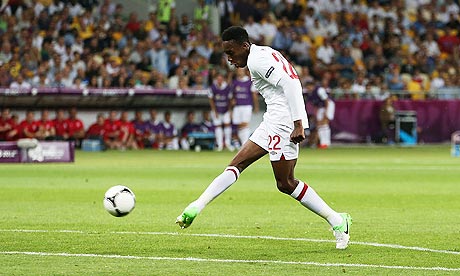
Constantly stripped of possession as easily as relieving a dandelion of its seeds,the second period was a positively painful affair for English fans.Italy relentlessly assaulted the English wall, led by the much maligned, yet stand out English performer, John Terry. But the English defensive bravery was more than matched by Italy’s attacking vigour. Hart saved again from Balotelli,Montolivo fired over, and De Rossi somehow skewed wide with the goal at his mercy. But, there was time still for England’s best chance of the match, as Danny Welbeck exchanged passes with Rooney, before side footing just wide of Buffon’s goal.

With England’s moment gone, the Italians resumed their barrage. Diamante hit a post once again, and substitute Nocerino thought he had nicked it right at the death, but was rightly adjudgedto be offside. It was a cat and mouse affair; with most agreeing that Tom had caught Jerry long before the end of extra time.

Italy racked up a staggering 31 shots, with 18 on target – compared to a dismal 8, with 6 on target for England.We might have been looking at the proverbial cricket score had the Italians brought their proverbial shooting boots. It mattered little however, as England still found themselves up a certain creek without a certain proverbial; largely due to their overly cautious nature, and inability to rise to the big occasion.

The old master, Pirlo, passed, picked, and placated for the Italians all the game long. It was chiefly his near perfect distribution that consistantly unlocked the English stubbornness. His natural elegance typified the clash of ideals that was on show. England huffed and puffed, always perceiving this game, and indeed the entire tournament, as an almighty struggle; a battle. But Italy, like other European giants successful on the big stage, adopt style, poise and an unwavering footballing ideology to their play. They may resort to idealistic tactics of pride and last ditch courage when necessary, but they do not use it as an all-encompassing blueprint. This, I feel, is where the root of the problem lies for a one dimensional England.

It has become very hard these days for pundits, players and fans alike not to use ‘like Chelsea’ as a throwaway adverb. Yet, all the ingredients seemed to be there. An imposing opponent, seemingly capable of swatting the English away like an irritation; a threadbare squad full of failures, futures and final hurrahs; an English goal seemingly erected with the addition of a large pane of glass; a manager unproven and unappreciated at this level; and we even had John Terry and Ashley Cole. Many could be forgiven for predicting an eventual, undeserved victory for the dogged English, and exuding careless optimism when penalies loomed. But they were reading from the wrong script; and I doubt even Chelsea hero Didier Drogba could have saved England from their own, all too repetitive, shortcomings.
Pictures: The Mirror, IBN Live, glogster.com, BBC Sport, eurosoccerweb.com

Saturday, 23 June 2012

Bits and Spanish

It's looking more and more like either Germany or Spain will emerge triumphant in Euro 2012, bar some serious upsets. The Germans continue to march imperiously on and through every obstacle thrown against them; and the Spanish intricately pick their way to victory. So, can the great German tank roll over the subtle Spanish bacterium when/if they meet in the Olympic stadium in Kiev?

Personally, I'm hoping for a German victory. Many are saying that their football is hard and basic, much like taking a sledgehammer to a door, rather than using the handle; but even more are saying that the Spanish are starting to irritate. Their no striker ploy is pretentious at the least. What Vicente Del Bosque is thinking when he brings on the like of Jesus Navas and Cesc Fabregas, when the lethal Fernando Llorente is sat sitting, warming his heels, I don’t know. The stats speak for themselves; Spain have only scored more than one goal in a match when playing with a striker. They drew one a piece with Italy, and beat the Croats with the same one goal. Torres isn’t really helping my argument, what with being as profligate as a dead chicken and all, but the little, ‘tika-taka’ Velcro gnomes have made chance after chance for him, and a striker on form would have buried a dozen. Even he's scored twice!
Spain, and indeed Spanish players, have been revered in the last 5 years, and are seen as the pinnacle of the beautiful game. But from where I’m standing, I only see real penetration from Spain in only about 20 minutes of the 90. They don’t really make for an entertaining watch, and are perfectly happy making pretty patterns with the ball for most of the match, pausing momentarily to score, as if it were an annoying by-product of their art.
The Germans on the other hand, are efficient, industrious, and clinical. I disagree with the idea that they’re dull. How can a team containing the likes of Ozil, Gomez, Muller, and Schweinsteiger be dull?! Not only do they have a brilliant first eleven, with no conceivable weakness, they also have real explosive talent pushing through from the bench. Marco Reus, Andre Schurrle, Mario Gotze and Toni Kroos are all exceptional attacking talents, and will undoubtedly become greats of the future game.


Oh, they beat the Greeks. Surprise…

Links: BBC Sport

Tuesday, 10 January 2012

The Man who would be Messi


Lionel Messi has won the Ballon d’or for the third consecutive year, one of four players to win this award three times. His talent is extraordinary. Still at the early age of 23, he is considered to be one of the greatest players there has ever been. Managers, fans, players and pundits are united in agreeing that his abilities are on a level with the likes of Pele, Maradona and Zidane. He has won everything to be won in football at club level. Where, we ask ourselves, will the little magician be in five years? Could Messi become even better when he reaches what is considered to be the prime of a footballer’s career?

Starting in the lowly suburbs of Rosario, Argentina – his abilities were noticed even from the age of 5. His body however, did not experience the same growth as his footballing prowess. A growth defect was discovered whilst playing in the youth team of Newells Old Boys. The price of treatment was too much for the Argentinian club. Thankfully, for all of us, Barcelona stepped in to whisk the youngster and his family to Catalonia in order to continue his development and receive the best treatment. Their faith has been well repaid.
                                                Top left, a god in the making. He's tiny!!

Statistically, Messi is unbelievable. Only Cristiano Ronaldo comes close. In the 2008-09 season, at only 19, Messi managed 38 goals and 18 assists in 51 games. Barcelona won the treble that year. He surpassed his goal scoring record the next year when he managed 47 goals; and then again last season with 53. This year, unsurprisingly, he has more goals than games with a remarkable 31 in 28 games, with 14 assists. He is unstoppable, in every sense.


What makes Messi that little bit more special is his humble attitude. Always smiling, it is a joy to watch him have fun on the field. Too often we see arrogance and anger in football, and although this cutthroat attitude is deemed a positive attribute by many, surely there is no greater pleasure than watching a player visibly enjoy himself as he overcomes all challenges put before him? His dedication of his latest player of the year award to his teammate Xavi is testament to his brilliant professionalism and likable demeanour. It also highlights how much he appreciates the efforts of colleagues such as Xavi, iniesta and Villa in his rise to stardom.


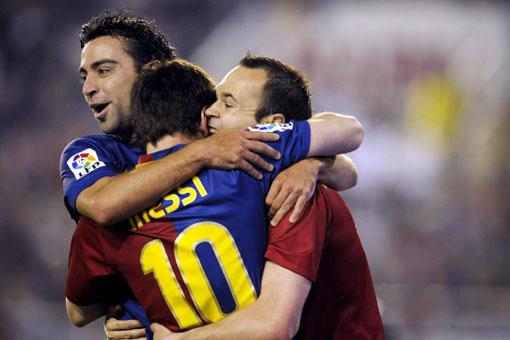
For all Messi’s brilliance, there are those who work behind the scenes. Xavi and Iniesta for example, are to Barcelona as cogs and working parts are to a clock. The ‘Velcro gnomes’ are the brains behind the outfit, passing their opposition into oblivion.  Their influence is evident in Messi’s game, as they allow the little Argentine to express himself. As a team, Barcelona are unparalleled. With their togetherness and collective abilities, they complement each other in every way – with Messi the jewel in the crown.
Pep Guardiola said in 2008, "Xavi is a player who has the Barcelona DNA: someone who has the taste for good football, someone who is humble and someone who has loyalty to this club. From the first moment I saw him play, I knew he would become the brain behind Barcelona for many years to come. He plays very, very well & much better than I ever played even when I was at my best."
With players like Xavi behind him, it gives Messi the best possible foundation in order to push his personal abilities and put into practice pieces of ingenuity other players can only dream about.

             The passing is slow and methodical, but the end result is devastating

I will happily observe as Lionel Messi continues to write himself into the record books, smashing all records and obliterating defences for many years to come. My wish? To take my place in the towering echelons of the Camp Nou and see the Little Flea with my own eyes. Even then, I probably won’t believe what I’m seeing.

Pictures: Offside/L'Equipe, BBC
I do not own these videos

Monday, 21 November 2011

In the beginning...

So I begin, with Tottenham sailing into third place at the expense of Aston Villa. A Tottenham side full to the brim with rich attacking potential and invention, and a defense, so often an easy source for critisism, with enough to compliment. Emmanuel Adebayor scored the two goals, his second being one which any striker dreams of; the ultimate tap in. Spurs were omnipotent in their dismantling of Villa, a real signal of intent to all those who dare oppose their rise from non existence to real challengers this year. 


I suppose I must liken myself to those men in white, as my humble blog takes form after much deliberation and stalling, much like the slow start exhibited by Tottenham. Yet, I imagined my rise to the medium of blogging to be on the back of a monumental win; one which has befallen many of the top teams this year. This season has already been one of the most interesting, debate-worthy and confusing of the Premier League's illustrious history - I hope my offerings provide at least two of those features! 


Welcome to The Good, the Bad and the Ribery... It looks to be a bumpy ride!